OCTOBER 15 – 17, 2019
LAWRENCE BERKELEY NATIONAL LABORATORY
Julia Morgan Building
UC Berkeley Botanical Garden
Berkeley, CA
ORGANIZING COMMITTEE
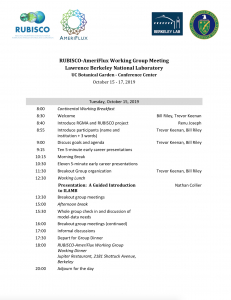
AGENDA
REGISTRATION
Registration is now closed. Please email Bill Riley or Kim Sopher to inquire about the possibility of late registration.
CONFERENCE LODGING
LOCAL RESOURCES
The Workshop on Analyzing Observations and Models of Carbon, Energy, and Water Fluxes will be held at the Lawrence Berkeley National Lab in Berkeley, CA on October 15 – 17, 2019.
This meeting will initiate a long-term working group focused on facilitating development, testing, and application of methods to use observations from eddy covariance sites to improve process understanding and land models. The working group, a collaboration between DOE’s RUBISCO Scientific Focus Area and the AmeriFlux Management Project, will bring together scientists at multiple levels across a broad range of fields. A novel aspect of the Working Group is an incubator for early career scientists with support for extended visits to Berkeley Lab to develop research projects and leverage facilities and expertise of the RUBISCO and AmeriFlux teams. Expected outcomes include long-term collaborations, follow-on focus groups, and publications.
The workshop, and the ongoing working group, will use AmeriFlux data to improve process understanding and to develop, parameterize, and test models. We will focus on the following themes through breakout sessions and plenary sessions at the meeting:
- Multifactor ecosystem responses to climate change, extreme events, and changes in seasonality using e.g., Ameriflux, phenocam observations, remote sensing products, observations from citizen science programs, and others.
- Roles of extreme events and “return times” on ecosystem resilience.
- Long-term trends in light use efficiency, water use efficiency, evapotranspiration, and other quantities, some of which may yield new emergent constraints
- Advanced mathematical analyses of time series of ecosystem dynamics to infer underlying controls across temporal scales
- Synthesizing new observations from data sets across spatial and temporal scales (e.g., AmeriFlux, remote sensing, disturbance maps, SIF, etc.)
- “Super site” benchmarks developed around stable, long-running flux tower sites with a diversity of collocated measurements (e.g., AmeriFlux, CZOs, LTER, NEON)
- Spatial scaling methods to interpret point measurements, incorporating ancillary databases, to study areas, regions, continents, and the globe.